
October 10, 2026
The gut has become one of the most fascinating places to study health. For a long time, microbes were mainly seen as possible causes of disease. Today, we know that many of them are important partners. The gut microbiota, the community of bacteria and other microorganisms living in the intestine, helps break down food, produces useful molecules, supports the immune system, and influences how the body responds to stress and disease. This matters in very practical ways. A healthy gut can help animals grow well, recover from stress, and resist disease, while a disturbed gut can make illness more severe or recovery more difficult.
This close relationship between an animal and its microbes is called host-microbe interaction. In simple terms, it means that the host and its microbes live together and constantly influence each other. When this relationship is balanced, it can support health. When it is disturbed, the whole gut environment can change. My name is Anh Vu Nguyen, and I am a DC6 doctoral candidate in the HoloGen network. I work as a doctoral researcher at Afekta Technologies Ltd. in Finland. In my PhD project, I study host–microbe interactions in poultry through two disease models: histomonosis and fowl adenovirus infection. These diseases are important because they can affect bird welfare, growth, and poultry production. The histomonosis trial allows me to study what happens to the gut during infection, and whether vaccination can help protect not only the bird, but also the normal functions of its gut microbes. The adenovirus trial asks a different but equally important question: when antibiotics are used during infection, how do they affect the gut microbiota, the chemical environment of the gut, and the bird’s recovery?
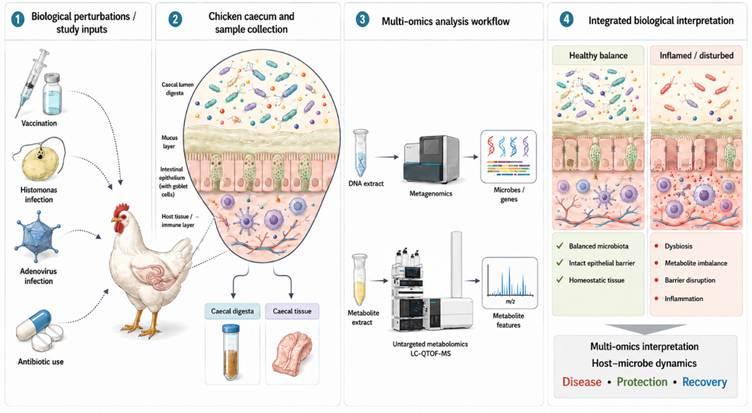
This figure shows how my PhD project connects poultry disease challenges with molecular tools to understand what happens inside the gut. We study how vaccination, histomonas infection, adenovirus infection, and antibiotic use affect the bird’s cecum (e.g., chickens shown in the figure). By analyzing cecal tissue and digesta using metagenomics and metabolomics, we aim to understand host-microbe interactions during disease, protection, and recovery.
Why study the poultry gut?
Poultry health is important far beyond the farm. Chickens and turkeys are major sources of food around the world, and keeping them healthy supports animal welfare, food security, and more sustainable production.
When birds become sick, they may suffer, grow more slowly, and require treatment. At the same time, we need better ways to prevent disease and use antibiotics responsibly. To do this, we need to understand not only what disease looks like from the outside, but also what happens inside the gut.
One important part of the poultry gut is the caecum. The caecum is a pouch-like region located near the beginning of the large intestine, where many microbes live and where important microbial activities take place. This makes the caecum a valuable place to study how disease, protection, and recovery are connected to the gut microbiota.
How can chemistry help us understand disease?
My role in the project is to study the chemistry of the gut using metabolomics. Metabolomics is the study of small molecules, called metabolites, in biological samples. These molecules include amino acids, fatty acids, sugars, bile acids, vitamins, and many other compounds. Some are produced by the bird, some by microbes, and some through cooperation between the two.
I like to think of metabolites as molecular footprints. They give clues about what has been happening inside the body: whether microbes are active, whether cells are under stress, whether inflammation is present, or whether the gut environment has been disturbed.
To measure these molecules, we use mass spectrometry. In simple terms, mass spectrometry is a technique that helps us “weigh” molecules and separate them based on their chemical features. A gut sample may look simple from the outside, but inside it contains thousands of chemical signals. Mass spectrometry allows us to detect many of these signals and compare how they change between healthy, infected, vaccinated, or antibiotic-treated birds.
In my project, we mainly use untargeted metabolomics. This means that instead of looking only for a few known molecules, we try to measure as many metabolites as possible and then ask what biological story they may tell.
This is one of the parts of my PhD that excites me most. My background is in analytical chemistry, and I became fascinated by mass spectrometry during my previous studies and research training. Before starting my PhD, I had the chance to work with lipidomics and spatial metabolomics, which showed me how powerful chemical analysis can be for understanding biology. These experiences shaped how I see analytical chemistry: not only as instruments and data, but as a way to understand life through molecules. Now, at Afekta, I apply this interest to poultry health.
What disease models do we study?
In my PhD, I work with two main poultry disease models. We chose these models because they represent different types of gut-related disturbance. One allows us to study infection and vaccination, while the other allows us to study viral infection together with antibiotic use. Together, they help us ask how different challenges change the host, the microbiota, and the chemical signals between them.
The first model focuses on Histomonas meleagridis, a parasite that causes histomonosis, also known as blackhead disease. This disease affects the gut, especially the caecum, and can cause serious tissue damage. Treatment options are limited, which makes prevention and vaccination especially important.
In this trial, chickens were vaccinated or left unvaccinated and then challenged with the parasite. We collected samples from both caecal tissue and caecal digesta. The tissue tells us more about the bird’s gut wall, while the digesta, the material inside the gut, tells us more about the gut contents and microbial environment. By studying both, we can look at two connected sides of the disease: the host response and the microbial environment.
The second disease model focuses on fowl adenovirus infection and antibiotic use. Here, the question is slightly different. We want to understand how viral infection and antibiotic treatment affect the bird, the gut microbes, and the molecules they produce. Antibiotics are important for treating bacterial infections, but they can also disrupt the gut microbiota. Better understanding these effects can help us use antibiotics more carefully, protect beneficial microbes, and support recovery after disease. By studying this model, we hope to learn how infection and antibiotics change the gut during disease and recovery.
Together, these models allow us to study how different biological challenges influence the host, the microbiota, and the chemical signals that connect them.
How does HoloGen bring the pieces together?
This is where the wider HoloGen approach becomes especially valuable. Metabolomics gives us information about small molecules, but it is only one layer of biology. Other approaches can add more pieces to the puzzle.
Metagenomics can tell us which microbes are present by reading their DNA. Metatranscriptomics can help show which microbial genes are active. Clinical observations from our collaborators, such as body weight, disease signs, tissue lesions, and pathogen detection, help us connect molecular changes to the actual health of the birds.
By bringing these layers together, we can begin to see a more complete picture. For example, if certain microbes change, microbial metabolites decrease, and the birds also show stronger disease signs, we can start to ask how these events may be connected. One dataset alone cannot explain everything, but each layer helps us understand the host-microbe relationship more clearly.
What makes this project meaningful to me?
For me personally, this project is also a journey into a new field. I came into HoloGen with a background in analytical chemistry and mass spectrometry, but host-microbe interactions and multi-omics were still new to me. Learning how to connect chemical data with microbiology, animal disease, and animal welfare has been challenging, but also very rewarding.
Every dataset feels like a puzzle. There are thousands of molecular signals, and each one may carry a small piece of information about what happened inside the animal. Some signals may reflect microbial activity. Some may reflect inflammation. Some may show damage, recovery, or protection. My task is to carefully connect these signals into a biological story.
By the end of my PhD, I hope my work will help explain how infection, vaccination, and antibiotic use reshape the gut environment in poultry. More broadly, I hope it will show how metabolomics can contribute to better animal health research. To me, poultry diseases are not only scientific problems. They affect animal welfare, food production, and the responsible use of medicines. If we can better understand how infections disrupt the gut, how vaccines protect animals, and how antibiotics influence recovery, we can support more effective strategies to keep birds healthy.
The gut is full of chemical messages. With the right tools, we can start to listen to them. And sometimes, those small molecules can tell us a much bigger story.